Updated 2026-10-15 · 9 min read
Tango show or milonga: where to spend an evening in Buenos Aires
A tango show offers a seat for a staged performance; a milonga is a social dance where you can watch or join in. Choose by the kind of evening, timing and booking arrangements you want.
In short
- A show is an audience seat for professional dancers; a milonga is a social dance where you can sit and watch for the evening.
- Compare the venue’s current show-only and dinner-package tickets, including transfers and drinks. Ask the milonga organiser whether a class is included in admission and what any additional class charge would be.
- At a milonga, the cabeceo is a look and nod across the room that invites someone to dance a whole tanda.
- Evening milongas often peak around 00:30–02:30, after the Subte has closed.
- Twice-weekly classes for two or three months give many beginners enough grounding for a relaxed milonga.
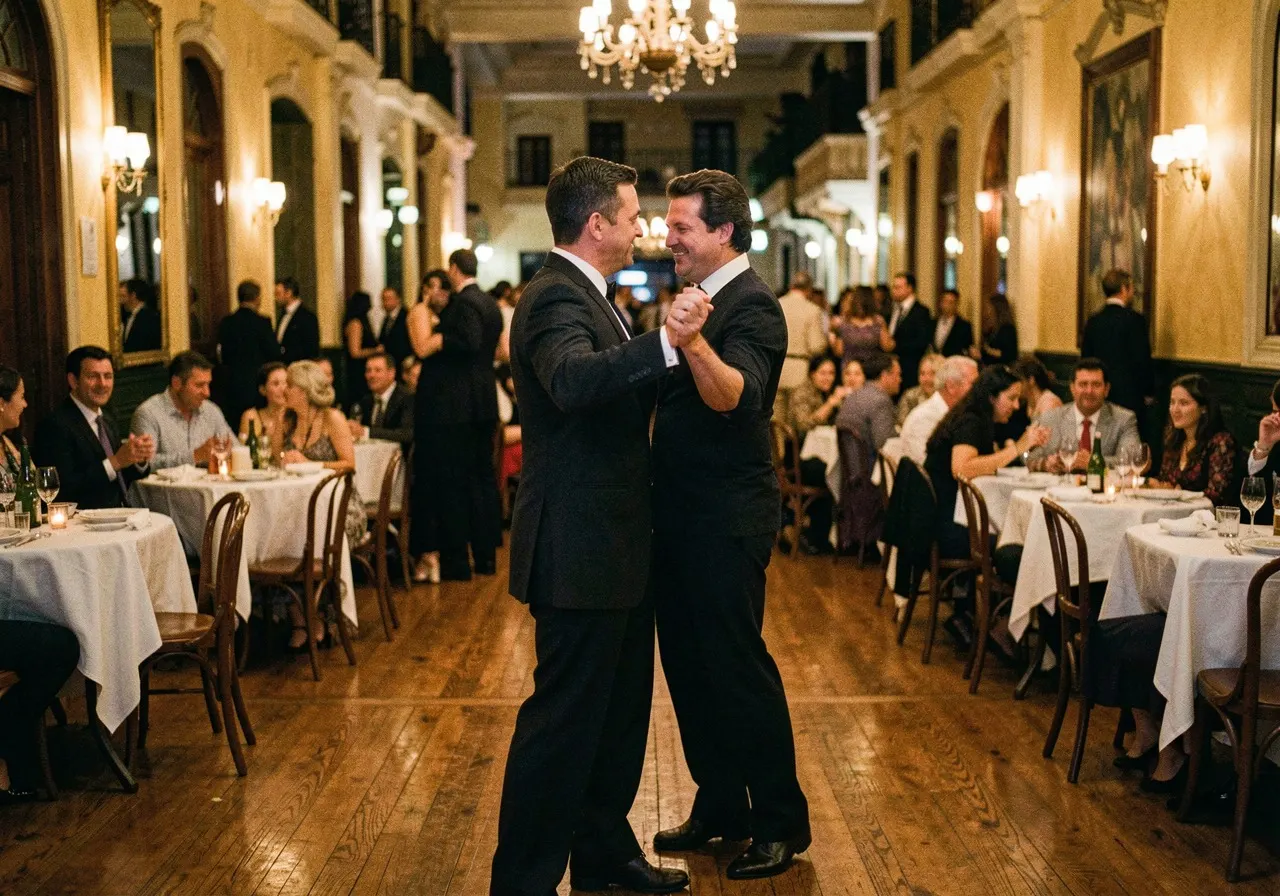
A tango show puts professional dancers on stage for you; at a milonga, people in Buenos Aires dance with one another. You can go to the latter just to listen and watch.
For visiting family, a show offers a complete evening and often a ride from a central hotel. For someone living here, a milonga can become a weekly night out, first from a table and later on the dance floor. Stage tango and social tango each have their own technique and pleasures; there is no need to dismiss one to enjoy the other.
Two kinds of evening
A show has a timetable: dinner from around 20:00, a performance around 22:00 and usually home by midnight. A milonga often runs from about 22:00 to 03:00, with its busiest dancing from 00:30 to 02:30; some have afternoon sessions. At the former, you buy an audience seat; at the latter, you pay to enter a social dance and may sit out every tanda.
| Tango show | Milonga | |
|---|---|---|
| On the floor | Professionals perform set routines, often with a live band | Dancers improvise together in a close embrace, walking anticlockwise |
| Arrangements | Book online or by phone a few days ahead; cards or dollars | Usually walk in, or reserve at a traditional venue; cash pesos |
| Clothes and language | Smart casual; no Spanish needed at big venues | Smart casual, dressier in traditional rooms; a few phrases help at the door |
| Finish | Usually by midnight | Often around 03:00; afternoon events also exist |
A dinner show might remind a British visitor of a West End musical with a set menu. A milonga has more in common with a regular dance night, with a host, familiar faces and etiquette that makes room for everyone on a shared floor. Some regulars have been coming for decades.
Where the stage shows happen
Most shows offer an optional steak or set-menu dinner, with wine included at mid-range venues and above. The performance typically lasts 70–90 minutes and brings together several couples, a singer and an orquesta típica, the tango orchestra with its bandoneón (a large concertina). Many venues offer a minibus pick-up from central hotels, useful for guests staying in Recoleta or Microcentro.
The choices range from the small, costly cabaret room at Rojo Tango, inside the Faena Hotel at Martha Salotti 445 in Puerto Madero, to the large Señor Tango hall at Vieytes 1655 in Barracas, which seats hundreds and attracts tour groups. Café de los Angelitos, Av. Rivadavia 2100 in Balvanera, pairs a restored historic café with a polished production. El Viejo Almacén, at Balcarce and Av. Independencia in San Telmo, is one of the longest-running show houses. Beside the Abasto shopping centre, Esquina Carlos Gardel at Carlos Gardel 3200 stages a large production in the area where Gardel grew up.
Café Tortoni, Av. de Mayo 825 in Monserrat, has a shorter show; at Bar Sur, Estados Unidos 299 in San Telmo, the musicians and dancers are a few feet away. Esquina Homero Manzi, Av. San Juan 3601 in Boedo, is another café with a show. Direct booking through the venue's site or by phone avoids hotel-desk and street-agent commission.
Look for the current public tango programme if you want to watch without buying a show package. Around Plaza Dorrego, couples dance for tips at the Sunday Feria de San Telmo on Calle Defensa. In Caminito, La Boca, dancers charge to pose for photos; agree the price first and visit in daylight. Check the city’s current Festival y Mundial de Tango programme for dates, events and ticket terms. Its Tango de Pista and Tango Escenario categories name the distinction between social-floor and stage dancing.
Finding a milonga and a seat
A milonga's tables surround the dance floor. The musicalizador (DJ) plays tandas of three or four songs by one orchestra, separated by a cortina, a short burst of other music that clears the floor. Couples travel anticlockwise in the ronda, or line of dance. Students share the room with dancers who have been coming for 40 years. The same hall can host different organisers and crowds on different nights, so Hoy Milonga's daily website and app listings are more useful than an old fixed schedule. Queer milongas, where anyone can lead or follow, run regularly but move venues; LGBTQ+ life in Buenos Aires has more on the wider scene.
| Milonga | Where | What kind of night |
|---|---|---|
| La Viruta | Armenia 1366, Palermo; basement of the Armenian cultural centre | Relaxed, mixed ages and levels, with classes first; good for a first visit or dance |
| La Catedral Club | Sarmiento 4006, Almagro | Informal old warehouse, younger crowd; easy to watch with a drink |
| Salón Canning | Av. Raúl Scalabrini Ortiz 1331, Palermo | Busy, with live bands some nights and accomplished social dancers |
| El Beso | Riobamba 416, Balvanera | Small, traditional room with strict codes |
| Club Sin Rumbo | José P. Tamborini 6157, Villa Urquiza | Neighbourhood club with older regulars and old-style dancing |
| Club Gricel | La Rioja 1180, San Cristóbal | Traditional, well dressed, suited to confident dancers |
| Club Villa Malcolm | Av. Córdoba 5064, Palermo/Villa Crespo border | Younger improvers, sometimes modern music |
| La Glorieta | Bandstand, Barrancas de Belgrano | Check the organiser’s current schedule and admission terms |
Going only to watch is ordinary here. A host can seat you at a table para mirar (to watch); ordering a drink is the unwritten price of keeping the seat. In traditional rooms men may sit on one side, women on the other, and couples or groups between them. Tell the host you have come together so the group can sit together. Filming dancers calls for their permission, and flash is out of place.
A first evening at La Viruta or La Catedral Club is relaxed enough to take in the room. Salón Canning and El Beso are particularly good places to watch fine social dancing, though popular nights there can fill up: Hoy Milonga lists the organiser's number for a name-and-group-size reservation. More informal rooms are usually walk-in.
How the night works once you are inside
An early class can ease the transition into the milonga. Otherwise, an arrival around 23:00 leaves time to watch a few tandas before the busiest stretch at 00:30–02:30. For earlier hours, some traditional milongas begin in late afternoon. The organiser seats guests in traditional rooms, so an empty table is best left to the host to assign.
When dancers invite one another, the cabeceo is a look across the room answered by a nod. The pair meet at the edge of the floor and usually dance the entire tanda; saying ‘gracias’ midway signals that the dance is over. In the ronda, couples keep their feet low and their place in the anticlockwise flow without overtaking. High stage kicks and lifts take up space that belongs to other dancers. Anyone heading for the bar or toilets walks around the floor rather than cutting through it.
Late finishes have a practical consequence: the Subte has usually stopped by the time people leave. Cabify, Uber or a radio taxi can be arranged from inside the venue.
From the table to the floor
For many beginners, two classes a week over two or three months make a first tanda at a relaxed milonga feel manageable. A práctica sits between class and milonga: dancers can stop mid-song to work out a step there, whereas a social tanda keeps moving.
Shoes with leather or suede soles make turns easier; rubber-soled trainers tend to grip. Specialist shops such as Comme il Faut sell handmade tango shoes, but smooth-soled everyday shoes are enough for the first few months. Argentine tango classes in London, Edinburgh, Manchester and other UK cities can teach the embrace and walk before a move here. Once dancing becomes a several-nights-a-week habit, Palermo, Villa Crespo and Almagro put many venues a short ride away. Search Palermo rentals on PlataPlace, where furnished flats are listed with their source and when they were last seen.
Planning a visit and a new habit
Consider a Palermo couple hosting parents visiting from Leeds: all four want to watch tango rather than dance.
A dinner-and-show package, show-only seats, and a Sunday San Telmo feria followed by watching a milonga are three different evenings. Ask the show venue for its current show-only and dinner-package prices, including transfers and drinks, and ask the milonga organiser what admission costs. With a show one night and a milonga another, the visitors see both stage and social dancing.
Plan the journey home with the Buenos Aires public transport guide, then check the operator's current timetable. If dance-floor codes are not what you want from a night out, the Buenos Aires nightlife guide offers other possibilities. For meeting people beyond tango, see making friends in Buenos Aires; for the Sunday fair and neighbourhood tango bars, the San Telmo guide puts them in their local setting. A show leaves you with a performance to remember; a milonga gives you a room you may want to return to next week.
Questions
- Should I choose a tango show or a milonga?
- A show gives visitors a complete stage performance, while a milonga gives a view of social dancing and a chance to take part later. Ask the show venue for its current prices and the milonga organiser about admission before you decide.
- How much does a tango show cost?
- Prices vary by venue and package, so there is no single figure. Compare each venue’s current show-only and dinner-package prices, including any booking fees, transfers and drinks.
- Can I visit a milonga without knowing how to dance?
- Yes. Ask the host for a table ‘para mirar’ and order a drink; people regularly spend an evening listening and watching. Invitations usually begin with a cabeceo, a look and a nod across the room.
- When does a Buenos Aires milonga get busy?
- Evening sessions commonly begin around 22:00–23:00 and the floor is fullest from about 00:30 to 02:30. Some traditional milongas run in the afternoon; Hoy Milonga carries each day's listings.
- What should I wear to a milonga?
- Smart casual works in most rooms; El Beso and Club Gricel tend to be dressier. Smooth-soled shoes help with turns, whereas rubber-soled trainers grip the floor.
- How can I check public tango events and admission terms?
- Use the current Festival y Mundial de Tango programme and the feria or La Glorieta organiser’s dated listing. Confirm the event, location, reservation requirements and admission terms; a public setting does not by itself establish free admission.
Sources
Related guides
- English book clubs in Buenos Aires: where readers actually meet
English-language readers in Buenos Aires can join Museo Casa Sarmiento's Thursday short-story club, a bilingual Las Argies café meeting or a smaller reading circle. Check each organiser for current fees and schedules.
- Buenos Aires nightlife: a British guide to bars and clubs
Buenos Aires evenings tend to unfold late: dinner around 9–10pm, drinks after 11pm and a boliche (nightclub) filling up around 2–3am. Palermo makes a straightforward first bar night, while a booked show in San Telmo or Almagro can get you home earlier. The event listing and the journey home matter more than any citywide timetable.
- Language exchange in Buenos Aires: find a partner and keep talking
In Buenos Aires, a language exchange can be a free, one-to-one English-Spanish conversation or a group event with its own entry terms. Tandem and HelloTalk help you meet a partner; Mundo Lingo and Meetup list events. Agree on 30 minutes in each language and budget for your own drink.