Updated 2026-09-27 · 9 min read
San Telmo, Buenos Aires: a neighbourhood guide for daily life
San Telmo suits people who want an old, walkable neighbourhood close to central Buenos Aires. The Sunday fair is part of life here, alongside older flats, Spanish-speaking errands and streets that change character after dark.
In short
- Plaza Dorrego hosts the Sunday antiques fair, while stalls and pedestrians spread along Defensa.
- The covered Mercado de San Telmo occupies the block bounded by Defensa, Carlos Calvo, Bolívar and Estados Unidos.
- Subte lines C and E meet at Independencia on the western side; a flat farther east may be better served by bus.
- A central Buenos Aires one-bedroom benchmark is about US$750 a month in September 2026, not a quote for San Telmo.
- In an older flat, damp, wiring, heating, water pressure and expensas can matter as much as the asking rent.
San Telmo makes sense if you want to walk towards the city centre, do your errands in Spanish and live among older buildings rather than newer towers. Its Sunday fair is a pleasure, but for someone renting beside Defensa it is also a weekly change to the route home. The block and the building make a greater difference to daily life than the neighbourhood name: see a prospective flat on an ordinary weekday evening as well as on a Sunday.
A few blocks make a different home
Walking south from the offices near Plaza de Mayo towards Plaza Dorrego, you reach smaller buildings, some cobbles, antique shops and cafés opening onto the street. Around Defensa and the plaza is the historic core. A flat above that stretch of Defensa hears and sees much more of the Sunday fair than one on a residential part of Bolívar. Near Parque Lezama to the south, there is a large park within walking distance, but the subte is farther away; the blocks towards Constitución change again when shops close.
Puerto Madero lies east across the large avenues, while the western edge around Independencia offers faster access to subte lines C and E and more traffic on the main roads. Near the Mercado de San Telmo, Carlos Calvo and Bolívar put food counters and side streets close by, although some counters have tourist-facing prices. These are useful differences for a search, not guarantees about every building. The Buenos Aires neighbourhood overview puts them alongside other barrios.
A map can make a station or supermarket look nearer than it feels with shopping bags. Cobbles and uneven pavements affect anyone with a buggy, wheelchair or rolling suitcase; an older building may also have entrance steps and no lift. The walk between your door, your usual shops and your route home tells you much more than a weekend photograph.
The Sunday fair becomes part of your week
The Feria de San Pedro Telmo began in Plaza Dorrego as an antiques fair in 1970. On Sundays, additional stalls, performers and visitors extend along Defensa; the antiques sellers in the plaza are distinct from the craft and food stalls on the street. A visit usually runs from roughly 10am into late afternoon, though the city's current listing is the place for official hours and holiday arrangements. Before 11am, it is easier to look at the antiques; by lunchtime the walk along Defensa slows considerably.
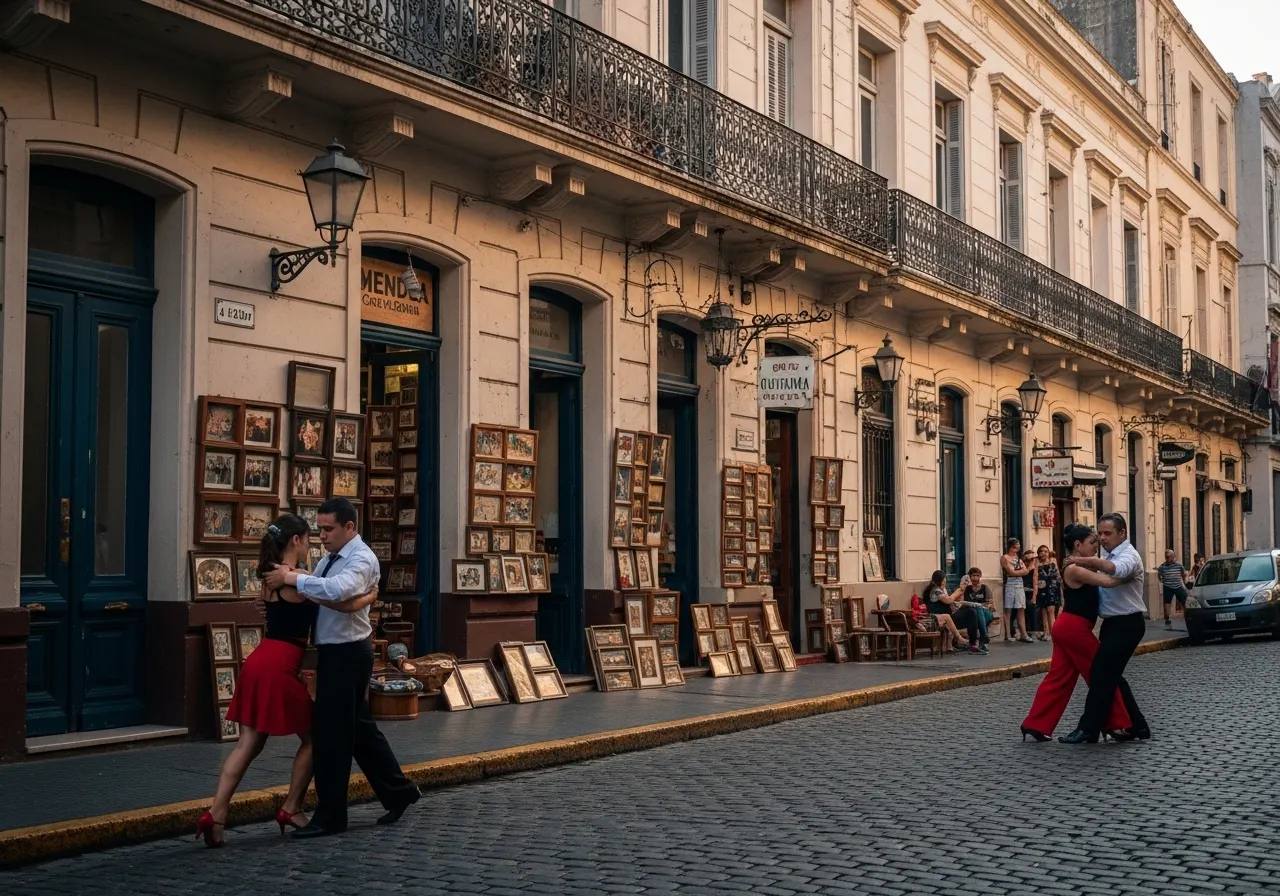
A household beside the fair has to account for it every week. Taxis and deliveries may need to meet residents on a wider parallel road rather than pull up on Defensa. In the crowds, a phone left on an outdoor café table or a bag hanging loose is an easy target. Close portraits of stallholders and performers call for a request first, including when a tango demonstration is drawing visitors.
The covered Mercado de San Telmo is a separate place you can visit midweek. Its 1897 iron-and-glass structure takes up the block enclosed by Defensa, Carlos Calvo, Bolívar and Estados Unidos. Produce sellers share it with antiques and food counters, so it works as a covered market of independent traders rather than a full-size Tesco. Hours vary by stall; at a greengrocer's, prices may be given by the kilo before the selection is weighed.
The places that become familiar
Plaza Dorrego is an easy meeting point; the market makes a reliable weekday lunch stop. On Defensa, El Desnivel at number 855 is a traditional parrilla (grill). La Brigada at Estados Unidos 465 is another known steak address, generally for a more elaborate meal, while Bar El Federal at Carlos Calvo and Perú is a historic place for coffee or a drink. Individual menus and opening nights change, so these are addresses rather than promises of a particular price.
There is more to the neighbourhood's cultural life than the tango performed for visitors. Bar Sur at Estados Unidos 299 is associated with performances; at a milonga, people dance socially rather than watch a staged dinner show, and a class introduces the etiquette. The Museo de Arte Moderno de Buenos Aires at Avenida San Juan 350 and the Museo Histórico Nacional at Parque Lezama make very different regular outings, with exhibition days and ticket rules on their official pages. El Zanjón de Granados at Defensa 755 is a guided-tour heritage site, so a visit is arranged rather than improvised at the door.
The Gibraltar at Perú 895 is a British-style pub, and Walrus Books at Estados Unidos 617 sells English-language books. They can help you find your feet without making every social occasion an English-speaking one. Returning to a class or local café gives the faces behind the counter time to become familiar; making friends in Buenos Aires explores other ways to meet people. 'La cuenta, por favor' asks for the bill, which a group often settles at the table rather than splitting automatically into separate card payments as in many UK pubs.
The route to work, and the route back
Line C stops at Independencia and San Juan on San Telmo's western side, and line E also calls at Independencia. C runs towards the central interchange, where you can change for D towards Palermo and Belgrano. From the eastern blocks, a colectivo (city bus) may beat a walk west to the subte followed by a change. BA Cómo Llego and the city's transport pages show current routes and fares; fare revisions and inflation quickly make a quoted fixed price stale.
City transport generally uses SUBE, the rechargeable Sistema Único de Boleto Electrónico card. Payment options and discounts depend on the service, rather than following the same rules as London's Oyster system or always accepting a UK bank card. The Buenos Aires public transport guide explains the card and routes in more detail. In daylight the central streets are easy to walk; after a late class or drink, a familiar well-lit route or booked car may be preferable to an unfamiliar shortcut towards Constitución.
What the rent leaves out
San Telmo has renovated furnished flats, older unfurnished homes and short-stay lets, so a single neighbourhood-wide rent would conceal more than it reveals. A central Buenos Aires one-bedroom benchmark is around US$750 a month in September 2026, not a price for a particular San Telmo street. At the official exchange rate of about ARS 1,545 per US$ that September, US$750 is roughly ARS 1,158,750. Rent is only part of the monthly bill: expensas (shared building charges), electricity, gas, water and internet need their own lines, with clarity about what the owner pays.
Consider two people working from home who compare an illustrative older flat at US$650 a month near Plaza Dorrego with one at US$800 nearer the western stations. These are comparison assumptions, not live offers or neighbourhood averages. The US$150 monthly difference is about ARS 231,750 at the September 2026 rate, or US$1,800 over twelve months before bills. An extra 20-minute walk each way on 20 working days adds roughly 14 hours in a month; high expensas on the second flat could reverse any apparent saving. The useful comparison is the full cost beside the actual journeys.
Older buildings merit a slow viewing. A weekday visit after work and another on Sunday near Defensa show different noise levels; each viewing may take 30–45 minutes, plus a separate walk along the route home. A bedroom heard with its windows shut can reveal a bar or restaurant downstairs. Hot and cold taps running together, the toilet, signs of damp behind furniture, window catches and heating in winter all say something about how the home functions. Tall ceilings and thin windows can make a cold flat. Someone working remotely also needs to test the mobile signal and see a live internet speed test, and should ask when the wiring was last updated.
Before terms are agreed, the written monthly picture should cover rent, expensas, which utilities each party pays, deposit, furnished inventory, currency and the formula and frequency of increases. DNU 70/2023, a decree of necessity and urgency, repealed the old rental framework: parties can agree the term, currency and adjustment frequency rather than relying on a UK-style fixed monthly rent or an automatic statutory term. At handover, dated photographs of meters, stains, appliances and window catches sent with an inventory to the owner or agent, with their acknowledgement retained, can settle later questions about pre-existing damage.
San Telmo rentals on PlataPlace show the range of advertised stock. Availability, expensas and the precise address matter before a viewing, and a listing that claims the fair is outside the window is no reason on its own to transfer a holding sum.
Reading a street at different hours
The risks change with the hour. A packed Sunday fair calls for a fastened cross-body bag and care with a phone near the kerb or on an outdoor table. A quiet side street late at night calls for attention to lighting and open businesses rather than a rule to stay on Defensa, which itself can empty out. Towards Constitución, a booked car may make more sense than trying an unfamiliar block on foot.
For emergencies in Buenos Aires City, 911 reaches police, 107 reaches SAME ambulance services and 100 reaches fire services. Having your address and nearest cross street in Spanish, along with enough cash or a card for the journey home kept separately, is useful if a night goes wrong. The Buenos Aires safety guide gives the wider city picture.
San Telmo asks more of someone who wants a modern lift building, reliably quiet weekends or most errands in English. Palermo has more English-speaking services and a wider choice of newer flats; Belgrano may suit a family whose day revolves around green space rather than Plaza Dorrego. Each still comes down to an individual building. For San Telmo, the revealing visit is often a plain midweek morning, when you can tell if you enjoy the neighbourhood without the fair.
Questions
- Is San Telmo a good place to live in Buenos Aires?
- It can suit someone who enjoys walking, older buildings and using Spanish for errands. The precise block matters: visit after work and on a Sunday to see how the fair and the quieter hours affect it.
- When is the San Telmo market on Defensa?
- The antiques fair in Plaza Dorrego and the wider street stalls on Defensa run on Sundays, broadly from late morning to late afternoon; before 11am is quieter. Check the city's listing for official and holiday hours. The covered Mercado de San Telmo is a separate year-round market with hours that vary by trader.
- Is San Telmo safe at night?
- The hour and your route make more difference than the barrio label. A well-lit familiar route or a booked car is sensible after a late evening, particularly near unfamiliar blocks towards Constitución; 911 is the police emergency number in Buenos Aires City.
- Does San Telmo have a subway station?
- Yes. Line C stops at Independencia and San Juan on the western side, and E also stops at Independencia. From an eastern flat, compare the walk to a station with a door-to-door bus route.
- How much does it cost to rent in San Telmo?
- There is no dependable single San Telmo price across furnished and unfurnished flats. A central Buenos Aires one-bedroom benchmark was about US$750 monthly, or ARS 1,158,750 at the September 2026 official exchange rate; add expensas and bills when comparing actual listings.
Sources
Related guides
- Recoleta neighbourhood guide: everyday life in Buenos Aires
Recoleta is a walkable, relatively quiet central Buenos Aires barrio with museums, cafés and useful transport, but its attractive old buildings can have costly upkeep. It suits people who want culture and errands on foot more than late-night bars; budget above the city's roughly US$750 central one-bedroom benchmark (September 2026).
- Flores, Buenos Aires: transport, rent and daily life
Flores, Buenos Aires: two-room flats from about ARS 680,000 a month (August 2026), Subte A to Plaza de Mayo in 25 minutes, plus cheap clothing streets.
- Living in Belgrano, Buenos Aires: Rents, Commutes and Everyday Life
A two-bedroom flat in Belgrano rents for about ARS 1,350,000 plus ARS 220,000 in building charges (August 2026). The right part of the barrio depends on your commute.