Updated 2026-09-27 · 8 min read
Buenos Aires Photography: 12 Spots and the Best Times
Recoleta Cemetery opens at 09:00, the river catches sunrise and Puerto Madero comes alive at dusk. Twelve places, the best light and Argentina's image-consent rule.
In short
- The river faces sunrise; from the east side of Puerto Madero's docks, the sunset lights the warehouses behind the city.
- Recoleta Cemetery opens 09:00 to 17:00. Residents with a DNI enter free; foreign visitors paid ARS 24,030 (about US$16) in August 2026.
- April and May bring soft light and yellow plane trees; jacarandas peak in November.
- Blue hour falls about 15 to 30 minutes after sunset, which is around 20:05 in late December and 17:50 in late June.
- Article 53 of Argentina's Civil and Commercial Code requires consent to capture or reproduce an identifiable person's image, subject to three narrow exceptions.
For a river sunrise, head to Costanera Norte; for the lit docks after sunset, stand on the east side of Puerto Madero and look back towards the warehouses. Recoleta Cemetery is a morning stop, best in the first hour after its 09:00 opening. Those three places alone explain much of the city's photographic rhythm: the sun rises over the Río de la Plata and sets behind Buenos Aires.
The seasons change the picture too. April and May bring softer light and yellow plane trees, while the jacarandas peak in November. Argentina stays on UTC-3 throughout the year: sunrise and sunset are roughly 05:40 and 20:05 in late December, against 08:00 and 17:50 in late June.
Twelve places to photograph
A few of these stops reward an early arrival; Palacio Barolo and Teatro Colón instead depend on a guided tour. The rest can fit around the light and whatever part of the city you are already exploring.
| Spot | Where | Best time | What you get |
|---|---|---|---|
| Recoleta Cemetery | Junín 1760, Recoleta | First hour after 09:00 | Above-ground vaults; Eva Perón in the Duarte family vault |
| El Ateneo Grand Splendid | Av. Santa Fe 1860, Recoleta; Subte line D, Callao | Weekday morning | The 1919 theatre turned bookshop, seen from its upper boxes |
| Floralis Genérica | Plaza de las Naciones Unidas, Recoleta | Blue hour | Eduardo Catalano's 2002 steel flower |
| Costanera Norte | Beside Aeroparque, Palermo | Sunrise | The sun over the river and planes landing |
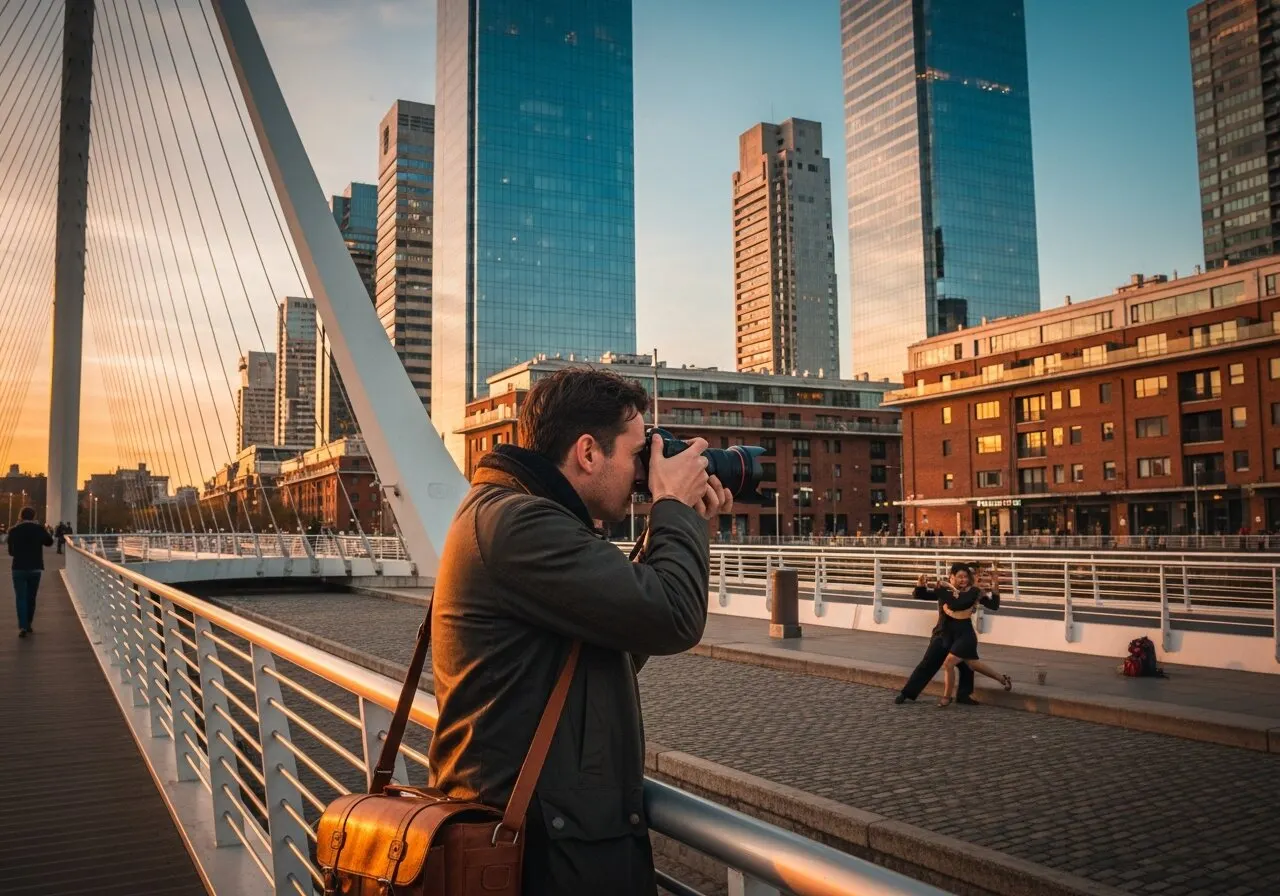
| Puente de la Mujer | Dique 3, Puerto Madero | Blue hour | Calatrava's 2001 footbridge against the lit docks |
| Obelisco | Av. 9 de Julio and Corrientes, San Nicolás | Blue hour | The 67.5 m monument, built in 1936, with traffic trails |
| Palacio Barolo | Av. de Mayo 1370, Monserrat; Subte line A, Sáenz Peña | Guided tour | The 1923 Dante-themed tower and a lighthouse view towards Congreso |
| Teatro Colón | Cerrito 628, San Nicolás | Guided tour | The 1908 horseshoe auditorium |
| Palacio de Aguas Corrientes | Av. Córdoba 1950, Balvanera | Clear daylight | The 1894 waterworks clad in Royal Doulton terracotta |
| Torre Monumental | Plaza Fuerza Aérea Argentina, Retiro | Any time | A British-community gift from 1916, called Torre de los Ingleses until 1982 |
| Caminito | La Boca | 10:00 to 13:00 | Painted corrugated-iron houses |
| Pasaje Lanín | Barracas | Daylight | Mosaic house fronts by Marino Santa María |
The Colón charges residents less than foreign visitors. Recoleta Cemetery opens from 09:00 to 17:00; entry is free for residents carrying a DNI (national identity card), while the foreign-visitor ticket was ARS 24,030 (about US$16) in August 2026.
Follow the light across the city
Buenos Aires sits well west of the meridian for UTC-3, which helps explain the late sun. At Costanera Norte the river faces sunrise; for sunset in Puerto Madero, the east side of the docks gives a view west towards the red-brick warehouses. Blue hour comes about 15 to 30 minutes after sunset, a useful window for Puente de la Mujer, Floralis Genérica and the Obelisco.
From March to May the light is generally clear and soft, with plane trees turning yellow in April and May. In winter, June to August, the noon sun reaches only about 32 degrees and architectural shadows stay long. Jacarandas flower from mid-October and peak in November; the roses also come out in the Rosedal, Parque Tres de Febrero's rose garden in Palermo. Summer, December to February, brings harsh midday light and storm skies. A lens can fog when brought straight out of air conditioning, so allow it a minute outside.
A November weekend can start at Costanera Norte before a roughly 05:40 sunrise, then move to Recoleta as the gates open at 09:00. Tour groups arrive after 10:30; El Ateneo Grand Splendid is a 15-minute walk away and its upper balconies are quieter earlier in the day. Plaza San Martín's jacarandas and the Torre Monumental across Av. del Libertador fit the afternoon, before a roughly 19:45 sunset at Puerto Madero and blue hour near 20:10. This route costs nothing beyond transport and a coffee if you carry a resident DNI; Palacio Barolo and Teatro Colón are separate paid tours, with smaller weekday groups.
Murals, markets and the people in frame
Around Plaza Serrano, officially Plaza Julio Cortázar, the streets of Palermo Soho carry murals, paste-ups and stencils, especially Thames, Armenia and Honduras. The Palermo neighbourhood guide gives more of the area. Villa Crespo and Barracas have larger murals with fewer people in frame, though walls are repainted often and a piece seen online may be gone. Graffitimundo runs English-language street-art walking tours for the stories behind the work.
On Sundays, Feria de San Telmo runs along Calle Defensa from Plaza de Mayo to Plaza Dorrego, with stalls, tango couples and bands. The 1897 iron-and-glass Mercado de San Telmo, entered from Defensa, gets soft light through its roof; there is more local context in the San Telmo neighbourhood guide. Further west, the Sunday Feria de Mataderos sits at Av. Lisandro de la Torre and Av. de los Corrales. This gaucho fair includes the sortija, in which riders spear a small ring at a gallop. At the San Telmo market, a tango couple may expect a tip or a price agreed before a posed picture.
Photographing people in Argentina
The rule for recognisable people is different from the general UK approach to public-place photography. Article 53 of Argentina's Civil and Commercial Code (Ley 26.994) requires consent to capture or reproduce a person's image or voice. Taking the picture and publishing it are separate acts: agreement to pose need not include agreement to publication. Consent can be spoken, written or implied by conduct, and it can be withdrawn.
Article 53 makes three exceptions: participation in a public act such as a march, match or festival; a priority scientific, cultural or educational interest where needless harm is avoided; and the regular exercise of the right to inform about events of general interest. Their scope depends on the circumstances. In December 2021, Sala D of the National Civil Court of Appeal found that a magazine's unauthorised use of a man's photograph in a World Cup deportation story fell outside the regular right to inform and awarded damages. Commentary also notes that article 55 treats doubtful consent as not given.
A wide street scene in which nobody can be identified raises a different issue from a frame centred on one face. For a close portrait, '¿Te puedo sacar una foto?' means 'Can I take your photo?' Ask parents before photographing children and leave children's faces out of published shots. Taking part in a public event covers that role, rather than every later use of the face. For commercial use of a recognisable portrait, article 31 of Ley 11.723, which remains in force alongside the Code, requires express consent; a signed autorización de uso de imagen (image release) records it.
A commercial shoot with crew or equipment on public ground also requires a city permit. BASet, the city's film office, processes filming and photography permits through TAD. The application calls for a DNI with a Buenos Aires address, a CUIT tax number and an insurance policy; applying is free, while filming permits have separate fees.
Carrying a camera around town
Phones can be snatched from hands or café tables, sometimes by thieves on motorbikes (motochorros). A cross-body bag keeps a camera closer than a neck strap, and a small mirrorless camera is less conspicuous than a DSLR with a long lens. Around La Boca, Caminito and its surrounding blocks are the daylight photography area.
A UK contents policy's personal-possessions cover usually ends when its holder moves overseas, so a resident of Argentina needs cover that applies there. Cameras, lenses and memory cards usually cost more locally than in the UK; spare batteries and cards are useful to bring. After a theft, 911 is the emergency number, and a denuncia (police report) from the local comisaría (police station) is the document an insurer will ask for. Drones fall under ANAC, Argentina's civil aviation authority; Aeroparque sits on the city riverfront.
The city also offers two very different excursions beyond these streets: the Tigre delta is about an hour away by train for water and wildlife, while mountains and glaciers mean a trip to Patagonia. In Buenos Aires itself, the most satisfying route follows the angle of the sun rather than trying to fit every landmark into one afternoon.
Questions
- When is the best time of year to photograph Buenos Aires?
- April and May bring soft light and yellow plane trees; November is the month for jacarandas. Winter's low sun gives long shadows, while summer light is gentler before 10:00 and after 18:00.
- Do you need permission to photograph people in Argentina?
- Article 53 of the Civil and Commercial Code requires consent to capture or reproduce an identifiable person's image, subject to narrow exceptions for public acts, priority scientific, cultural or educational interests, and reporting events of general interest. Ask before making a close portrait; commercial use of a recognisable face calls for express consent recorded in a signed release.
- Can I publish a photo of a crowd at a match or a march?
- Participation in a public act is one exception under article 53, and a wide crowd image where individuals cannot be identified presents less risk. Singling out one recognisable face or using it commercially raises a separate consent issue.
- Is Recoleta Cemetery free to enter?
- Residents with a DNI enter free; the foreign-visitor price was ARS 24,030 (about US$16) in August 2026. Gates open at 09:00 and close at 17:00, with the first hour quieter than later morning.
Sources
- Código Civil y Comercial, article 53, with commentary— Text of the consent rule and the three exceptions, plus the point that capturing and publishing carry separate consent.
- Microjuris: comment on an image-rights judgment— December 2021 appeals ruling on a photo published without consent, and the strict reading of consent under article 55.
- Recoleta Cemetery visitor information— Opening hours of 09:00 to 17:00, free entry for residents with a DNI and the foreign-visitor ticket price.
- Buenos Aires city: filming and photography permit— Public-space filming and photography permit: documents required, free application and separate filming fees.
- Sunrise and sunset times, Buenos Aires— Day lengths and sun times used for the late-December and late-June anchors.
- Graffitimundo— English-language street-art tours and workshops in Buenos Aires.
Related guides
- England vs Argentina: the football rivalry and how to watch it here
England and Argentina have played five times at the men's football World Cup. England won three, Argentina won one and advanced after a 1998 draw on penalties. The history behind the teasing, and how to watch a future match in Buenos Aires.
- Making friends in Buenos Aires: find somewhere to return to
The easiest introductions in Buenos Aires happen at recurring places: a free language exchange, a tango class or a five-a-side game. Returning often enough to recognise people is how an evening out becomes a social circle.
- Argentine Culture and Customs: A British Resident's Guide
A Buenos Aires invitation often begins with individual greetings and ends long after dinner. Here is how shared mate, later meals, restaurant bills and local Spanish work in everyday company.