Updated 2026-10-15 · 10 min read
Is Argentina Safe for British Tourists and Families?
Buenos Aires is a workable destination for British families. Phone theft, road crossings and disrupted routes deserve more attention than nationality; safety changes by street and hour.
In short
- For British visitors and families in Buenos Aires, phone and bag theft, traffic and demonstrations are more practical concerns than nationality.
- The exact route and time matter more than a 'safe barrio' label: a busy dinner street can be quiet after midnight.
- In Buenos Aires City, 911 reaches police, 107 reaches the SAME ambulance service and 100 reaches fire.
- Caminito and its established tourist streets are daylight visits; surrounding La Boca streets call for a planned return journey.
- After a robbery, personal safety comes first, followed by blocking cards and devices, making a police report and replacing any stolen documents.
Yes, Buenos Aires is a workable city for British families and visitors. The ordinary risks are a phone taken at the kerb, a bag left behind a café chair, traffic at a crossing or a journey disrupted by a demonstration. The useful question is less whether a whole neighbourhood is 'safe' than what the street and the journey will be like at the hour your family uses them. Save 911 for police, 107 for SAME ambulance and 100 for fire in Buenos Aires City; the FCDO's current Argentina advice covers changes and travel beyond the capital.
What deserves attention on an ordinary day
A map on a phone is easiest to read inside a shop or café, rather than at the roadside where someone on a motorbike could grab it. Bags stay closer in a crowded colectivo (city bus) or subte (underground) if the zip faces your body, especially around doors as passengers move. At an outdoor table, keep belongings with you instead of hanging a bag behind the chair or leaving a phone beside a coffee. These habits make more difference to a typical day than worrying about how a stranger might react to a British accent.
One distraction theft starts with someone spilling something on a passer-by and offering to clean it while an accomplice takes their belongings. Declining the help and stepping into a staffed business gives you room to regroup. If a thief threatens you directly, give up the item and get to safety rather than resisting.
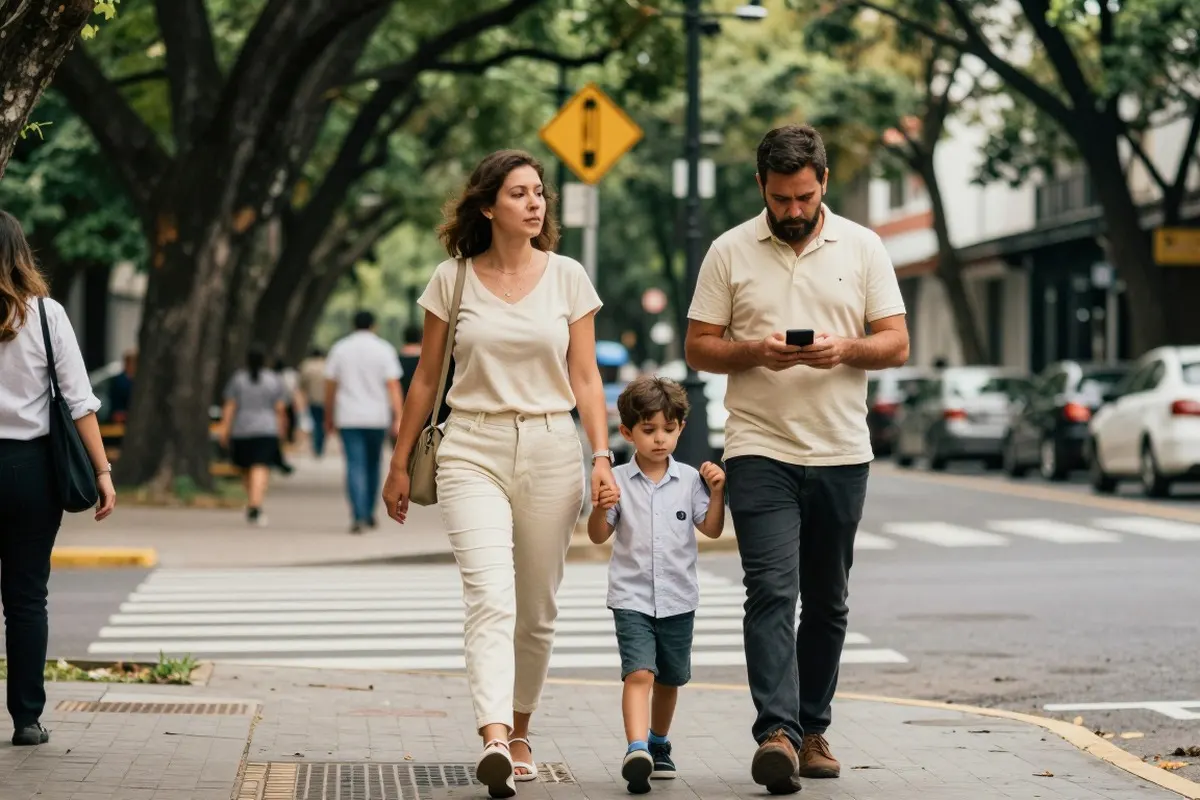
Roads require their own attention, especially with children. A vehicle may turn across a pedestrian crossing despite the walking signal, and motorbikes can come between stationary cars. Wait for vehicles to stop before crossing and hold a younger child's hand at corners. Around Plaza de Mayo and Congreso, marches can close streets and divert buses quickly; a family with a pushchair is better off taking another route than pushing through a crowd. Current disruptions, including those outside the city, belong on the FCDO Argentina travel advice.
The street matters more than the barrio name
Palermo, Recoleta, Belgrano and Núñez have well-used streets and family amenities. Each also has routes that empty later in the evening. San Telmo's Sunday market and a quiet nearby side street at midnight are two different journeys. This table describes useful route choices, rather than marking out safe and unsafe districts.
| Place and time | A practical route | Later in the evening |
|---|---|---|
| Palermo Soho and Hollywood, around Plaza Serrano or Plaza Armenia | Busy restaurant streets, with a bag kept close at outdoor tables | A booked ride can cover the final leg past empty residential blocks |
| Recoleta, around Avenida Santa Fe and the cemetery | Busy avenues for shopping and daytime walks | A lit main avenue or a booked ride avoids quiet park edges |
| Belgrano and Núñez, around Avenida Cabildo | The commercial corridor serves errands and transport | The walk from the stop to the door varies by side street |
| San Telmo, Defensa and Plaza Dorrego | Sunday market crowds call for closed bags | An empty side street feels different from the daytime market |
| La Boca, Caminito | Established tourist streets in daylight, with a return route planned | The visitor route is not a night-time walk through unfamiliar streets |
| Constitución or Once station areas | Know your exit and onward connection before arrival; mind luggage in crowds | A clear booked pick-up point avoids an unfamiliar station-area walk |
A railway underpass, the edge of a large park or a long walk from a station can count for more than the barrio name. When looking for a home, the useful test is the route from door to school and door to bus stop at the hours you will use them; a doorman changes the building entrance, not the walk towards it. The Buenos Aires neighbourhood guide gives a wider view of each district. Families comparing addresses can browse Buenos Aires rentals on PlataPlace, then see the actual block and evening transport for themselves.
A family journey that still works when plans change
A reliable school route has a simple fallback for a late pick-up, a diverted bus or a flat phone battery. An adult can walk it once in daylight and again at the expected return time, noticing the easiest crossing with a pushchair and a staffed shop or café where a child could wait. Agreeing a named station entrance or shop as a meeting point is more useful than saying 'outside'. A card with a parent's number and the home address in Spanish can live inside a younger child's bag; older children can memorise one number and know to approach a uniformed station worker or shop cashier for help.
At school, collection arrangements need to match its own rules. The school should have both adults' current contact details and know who is authorised to collect the child; a message sent only to the child may leave staff without the change. On a crowded bus or subte, the family can keep together at the doors with bags in front. When a normal route is blocked, the agreed staffed waiting place and a call home are safer than an improvised shortcut. The Buenos Aires transport guide explains everyday routes and transfers.
The phone plan matters to adults as well as children. A note of the device's IMEI, backup access to bank accounts and passport copies stored away from the originals make a lost phone or bag easier to manage. Device-finding and remote-lock settings are most useful when they are set up in advance. A family visiting San Telmo's Sunday market can agree on a meeting place before entering the crowd and check directions from inside a café while keeping sight of the children. None of this requires a paid safety service.
Arrivals and late journeys
On public transport, a bus stop with other people waiting is often more comfortable than an isolated stop serving the same route. A charged phone and an address written down separately help when mobile data fails. Keep the phone away from an open carriage door or platform edge; missing a crowded carriage is easier than being separated from a child while boarding.
For an unfamiliar late trip, app-booked rides such as Cabify or Uber and radio taxis offer a known pick-up. Official street taxis are black and yellow, but a booking makes it easier to match the registration and driver and share the journey details. Children can wait inside a restaurant or building until the car arrives. A request to switch to a different vehicle calls for a fresh booking, and reaching a car stopped across several traffic lanes is a poor trade for saving a minute. More on returning alone after a night out appears in the Buenos Aires safety guide for women.
At an airport or coach terminal, the indoor concourse offers time to settle the pick-up point, fare or app booking before heading outside with cases. Passports and one working means of payment are easier to protect on your person than in a suitcase. Taxi costs vary with time, route and traffic, so vehicle details and the displayed fare are more useful than a fixed fare quoted from memory. A route that works after an early family supper may feel very different after a football match or a transport shutdown.
If a phone, bag or passport is stolen
The first priority is to get everyone to a staffed shop, café or hotel. Someone facing a threat should hand over the property rather than follow a thief or resist. Once safe, the response separates into emergency help, control of accounts and documents for travel or insurance.
- In an active threat in Buenos Aires City, call 911 for police. SAME ambulance is 107; fire is 100. Give a street number and cross streets, plus the floor and flat if indoors. For a medical emergency, tell responders whether the person is conscious and arrange for someone to meet them if possible. Outside the capital, local arrangements vary; accommodation can help identify the local service.
- Freeze stolen bank cards, remotely lock the phone and ask the mobile operator to block its SIM. If the device was unlocked, change the email password from another device before resetting banking and other apps.
- Make a denuncia (police report) at the local comisaría (police station), giving known document numbers and keeping the case number and a copy for insurance. An insurer may have its own reporting deadline.
- For a stolen British passport, follow GOV.UK's lost-passport and emergency travel document guidance. The British Embassy in Buenos Aires is at Dr Luis Agote 2412, Recoleta, if consular help is needed. An emergency travel document depends on eligibility and itinerary, so the airline needs to confirm the onward flight arrangements.
Ask the hospital about non-emergency eligibility and charges for your exact residence category and its jurisdiction; a DNI alone is not confirmation of coverage. A UK Global Health Insurance Card does not provide a Buenos Aires health plan: visitors can keep their travel insurer's emergency line, while residents can keep their prepaga (private health insurer) assistance number. For a life-threatening emergency, call the public emergency service. Non-emergency appointments are covered in the day-to-day healthcare guide.
British nationality itself is no reason to avoid Buenos Aires. The Falklands, called Malvinas in Argentina, may come up in conversation around 2 April, a national remembrance day; a courteous change of subject is fine. Daily family life is made easier by knowing the routes, protecting the phone and having a plan if one journey changes. For schools and other parts of family routine, raising children in Buenos Aires looks beyond street safety.
Questions
- Is Argentina safe for British tourists?
- Generally yes, though a country-wide answer cannot describe every destination. In Buenos Aires, phone and bag theft, traffic and demonstrations are the most useful risks to plan for; check current FCDO advice for travel elsewhere.
- Is Buenos Aires safe to walk around at night with children?
- A familiar, busy evening route can work well for families. If the final streets are empty later at night, a booked ride from a clear pick-up point can be more comfortable than walking the last stretch.
- Is La Boca safe for tourists?
- Caminito's established tourist streets are a daylight visit. Plan the journey back and avoid treating unfamiliar surrounding streets as an extension of that visitor route after dark.
- What are the emergency numbers in Buenos Aires?
- In Buenos Aires City, call 911 for police, 107 for SAME ambulance and 100 for fire. Give the street number and nearest cross streets, plus the floor and flat if you are indoors.
- What should I do if my British passport is stolen in Argentina?
- Get somewhere safe, make a denuncia with local police and keep the report for insurance. Use GOV.UK's lost-passport and emergency travel document process and contact the British Embassy in Buenos Aires if needed; check eligibility and flight arrangements before travelling.
Sources
Related guides
- Is Buenos Aires Safe for Women? A British Resident's Guide
Many women live independently in Buenos Aires. A route's lighting, traffic and hour matter more than a barrio label, especially on a late journey home. In CABA, 911 is the police emergency number and Línea 144 offers round-the-clock gender-violence support.
- Childcare in Buenos Aires: Nurseries and Nannies for British Families
Private nursery fees and nanny costs in Buenos Aires depend on the school, the hours and ARCA's rules for domestic workers. Ask for current fee schedules and check ARCA's wage floors.
- Pharmacies in Buenos Aires: UK Medicines and Local Names
At a Buenos Aires farmacia, the active ingredient, strength and formulation are more useful than a UK brand name. Paracetamol is paracetamol, ibuprofen is ibuprofeno and amoxicillin is amoxicilina, which needs a prescription. For night duty, check that day's farmacia de turno and ring ahead.